
Coolant Temperature Sensor Resistance Chart (ECT Values, Voltage & Test Guide)
September 25 , 2023Updated October 1, 2026. Reviewed by the Focusens Engineering Team.
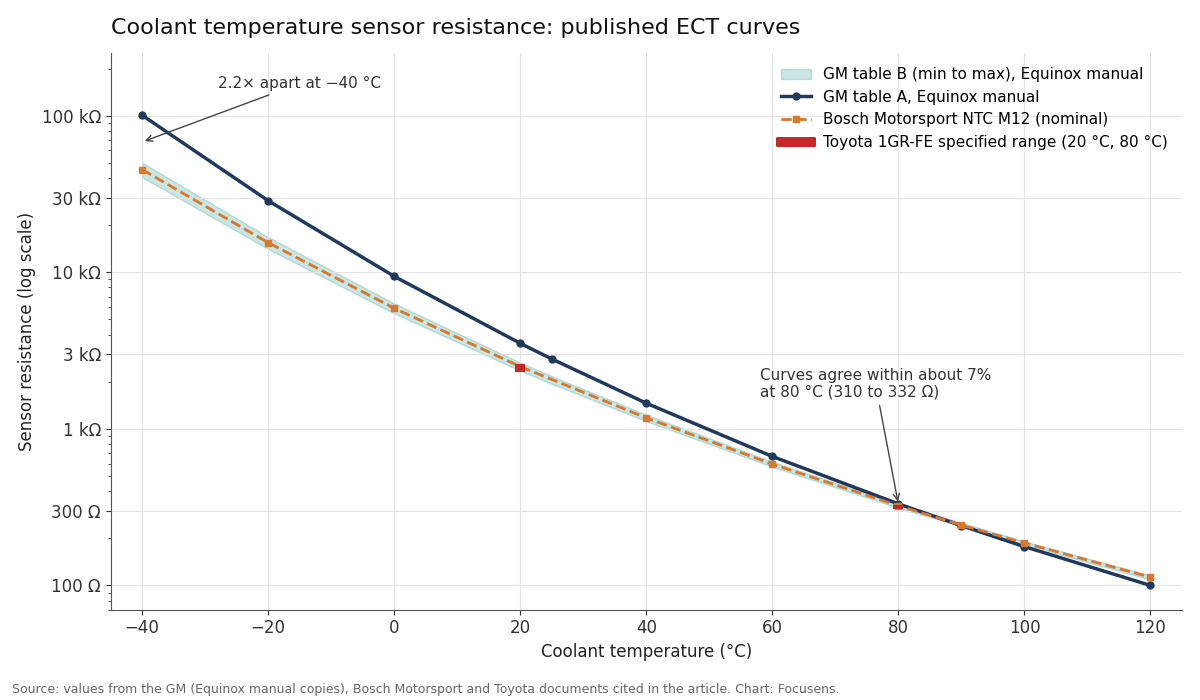
| °C | °F | GM ECT table A (Equinox manual) | GM ECT table B, min to max (Equinox manual) | Bosch Motorsport NTC M12 | Toyota 1GR-FE ECT (FJ Cruiser) |
|---|---|---|---|---|---|
| −40 | −40 | 100,700 Ω | 40,490 to 50,136 Ω | 45,313 Ω | |
| −20 | −4 | 28,680 Ω | 14,096 to 16,827 Ω | 15,462 Ω | |
| 0 | 32 | 9,420 Ω | 5,466 to 6,326 Ω | 5,896 Ω | |
| 20 | 68 | 3,520 Ω | 2,351 to 2,649 Ω | 2,500 Ω | 2,320 to 2,590 Ω |
| 25 | 77 | 2,796 Ω | 1,941 to 2,173 Ω | ||
| 40 | 104 | 1,459 Ω | 1,118 to 1,231 Ω | 1,175 Ω | |
| 60 | 140 | 667 Ω | 573 to 618 Ω | 596 Ω | |
| 80 | 176 | 332 Ω | 313 to 332 Ω | 323 Ω | 310 to 326 Ω |
| 90 | 194 | 241 Ω | 243 Ω | ||
| 100 | 212 | 177 Ω | 182 to 191 Ω | 187 Ω | |
| 120 | 248 | 100 Ω | 109 to 116 Ω | 113 Ω |
Sources: GM table A is the Chevrolet Equinox service manual table "Temperature vs Resistance Values (Approximate)", reproduced on a third-party site. GM table B is a second ECT table in the same manual copy; the copy does not say which engine each table belongs to. Delphi's data sheet for coolant temperature sensor 12146312 follows table A within about 2% from −40 to 120 °C (3,555 Ω at 20 °C, tolerance ±7.4%). The Bosch column is from the Bosch Motorsport NTC M12 data sheet, nominal 2.5 kΩ ±5% at 20 °C. The Toyota column is from the Toyota 1GR-FE repair manual specification (third-party copy), which lists only the 20 °C and 80 °C points.
Not every coolant sensor sits near 2.5 kΩ at room temperature. Delphi's 15425529 coolant temperature sensor is 10 kΩ at 25 °C. A 10 kΩ reading at room temperature is therefore not proof of a fault until you know which curve the sensor follows. On GM table A, 10 kΩ corresponds to about −1 °C (30 °F); on GM table B, about −11 °C (12 °F).
The ECT sensor tells the engine control unit (ECU) how warm the coolant is. The ECU uses that signal to set fuel mixture, ignition timing, idle speed and cooling fan operation, and it uses it most heavily during a cold start, when the mixture is enriched. A wrong reading at −10 °C matters more to the engine than a wrong reading at 90 °C.
The ECT sensor and the dashboard temperature gauge sender are not always the same part. Toyota, for example, sells a separate water temperature sender gauge assembly that "sends a signal to the vehicle's gauge system". On many newer vehicles the gauge has no sender of its own: the ECM passes the coolant temperature to the instrument cluster over the CAN bus, as the Nissan Altima service information (third-party copy) describes. Before replacing a part because the gauge looks wrong, check which design the vehicle uses.
An ECT signal runs from near 5 V on a very cold engine to under 1 V when fully hot (0.29 to 0.98 V at 90 to 100 °C in the table below). Toyota sets P0118 above 4.91 V and P0117 below 0.14 V. The ECU does not measure resistance. It feeds 5 V through a resistor inside the control unit to the sensor's signal terminal and reads the voltage left across the sensor. Mitsubishi's service manual describes this path and gives the supply at the unplugged connector as "between 4.5 and 4.9 volts". A cold sensor has high resistance and a high voltage; a hot sensor has low resistance and a low voltage.
The voltage at a given temperature depends on the resistor inside the ECU, which varies by vehicle. Bosch says its NTC M12 "can be connected directly to most control units using a pull-up resistor (typically 1 or 3 kOhm)". With the Bosch curve and a 5 V supply, the ECU would see:
| Coolant | Sensor resistance (Bosch) | Signal with 1 kΩ pull-up | Signal with 3 kΩ pull-up |
|---|---|---|---|
| −40 °C | 45,313 Ω | 4.89 V | 4.69 V |
| −20 °C | 15,462 Ω | 4.70 V | 4.19 V |
| 0 °C | 5,896 Ω | 4.27 V | 3.31 V |
| 20 °C | 2,500 Ω | 3.57 V | 2.27 V |
| 40 °C | 1,175 Ω | 2.70 V | 1.41 V |
| 60 °C | 596 Ω | 1.87 V | 0.83 V |
| 80 °C | 323 Ω | 1.22 V | 0.49 V |
| 90 °C | 243 Ω | 0.98 V | 0.37 V |
| 100 °C | 187 Ω | 0.79 V | 0.29 V |
Calculated as 5 V × R / (R + pull-up) from the Bosch resistance values. These are our calculations, not a published voltage table; your vehicle's service manual gives the values for its own ECU.
The two columns show why a single "normal ECT voltage" does not exist: the same sensor at 20 °C reads 3.57 V on one ECU design and 2.27 V on another. The Toyota limits are from the Toyota RAV4 service manual, engine coolant temperature circuit (third-party copy, 2AZ-FE engine).
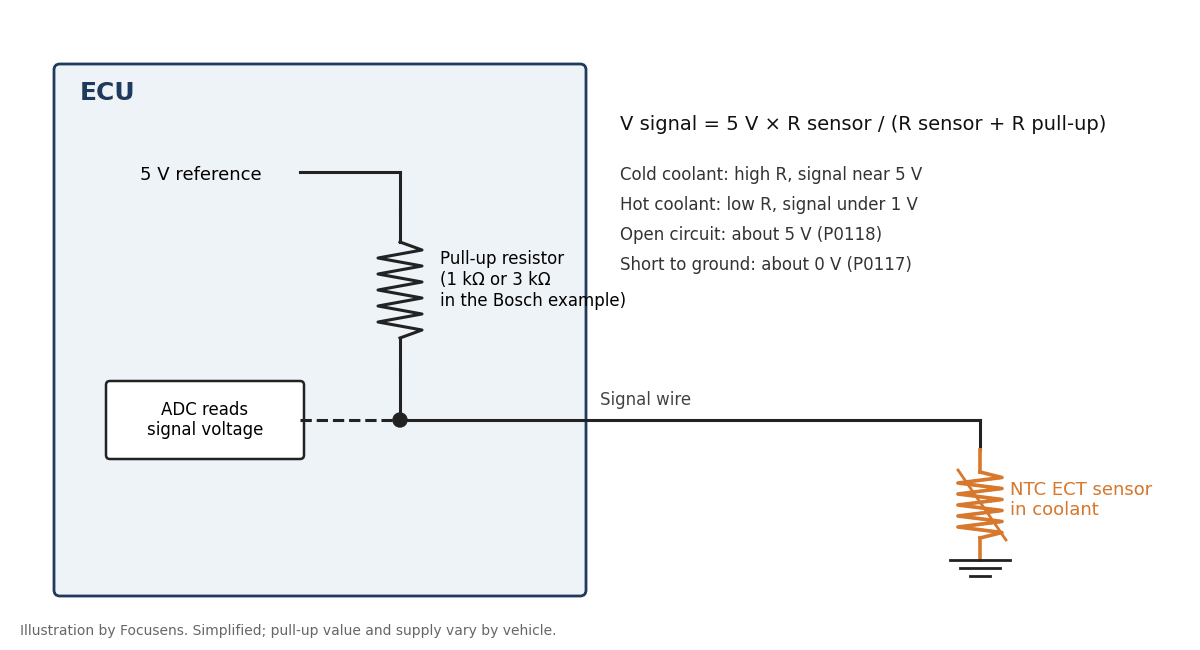
An open ECT circuit reads near 5 V and shows −40 °C (P0118); a short to ground reads near 0 V and shows 140 °C or higher (P0117), on Toyota's limits.
| Fault | Signal voltage | Temperature the ECU shows | Code (Toyota) |
|---|---|---|---|
| Open circuit: sensor unplugged, broken wire | Near 5 V, above 4.91 V for 0.5 s | −40 °C (−40 °F) | P0118 |
| Short to ground | Near 0 V, below 0.14 V for 0.5 s | 140 °C (284 °F) or higher | P0117 |
From the Toyota RAV4 service manual cited above. Toyota's Venza manual puts the short-circuit display at "Higher than 135°C (275°F)", so the exact figure varies by model. Mitsubishi uses similar limits: P0118 above 4.6 V and P0117 below 0.1 V, each held for 2 seconds. Both Toyota and Mitsubishi substitute a fixed 80 °C (176 °F) value while the fault is present, which is why an engine with a failed ECT sensor often runs, but runs poorly when cold.
The OEM wording of the related codes:
| Code | OEM description | Source |
|---|---|---|
| P0115 | Engine Coolant Temperature Circuit Malfunction | Toyota Venza manual |
| P0116 | Engine Coolant Temperature Circuit Range/Performance Problem | Mitsubishi |
| P0117 | Engine Coolant Temperature Circuit Low Input | Mitsubishi |
| P0118 | Engine Coolant Temperature Circuit High Input | Mitsubishi |
| P0125 | Insufficient Coolant Temperature for Closed Loop Fuel Control | Mitsubishi |
| P0128 | Coolant Thermostat (Coolant Temperature Below Thermostat Regulating Temperature) | Mitsubishi |
P0117 ("low input") means the voltage is too low, which the ECU reads as too hot. P0118 ("high input") means the voltage is too high, read as too cold. P0128 points away from the sensor: Mitsubishi sets it only after judging the ECT sensor normal, when coolant takes too long to reach 77 °C (171 °F), and lists a faulty cooling system or ECM as the likely causes.
Because ECT curves differ most when the engine is cold, a sensor with the wrong curve can look perfect on a warm engine. The table below takes the published Bosch resistance at each temperature and reads it back through GM table A, as an ECU calibrated to table A would.
| Actual coolant | Bosch-curve sensor reads (Ω) | Temperature on a table-A ECU | Error |
|---|---|---|---|
| −20 °C | 15,462 | −9.2 °C | +10.8 °C |
| 0 °C | 5,896 | 9.2 °C | +9.2 °C |
| 20 °C | 2,500 | 27.5 °C | +7.5 °C |
| 40 °C | 1,175 | 45.3 °C | +5.3 °C |
| 60 °C | 596 | 63.1 °C | +3.1 °C |
| 80 °C | 323 | 80.8 °C | +0.8 °C |
| 90 °C | 243 | 89.7 °C | −0.3 °C |
| 100 °C | 187 | 98.2 °C | −1.8 °C |
Calculated by interpolating ln(R) against 1/T between adjacent rows of GM table A. The same error appears inside one manual: the midpoints of GM table B, calculated as (min + max) / 2, match the Bosch values to within half an ohm at every temperature both list, so a table-B sensor read through a table-A calibration gives exactly these errors.
At 90 °C the error is a third of a degree, so a check with the engine at operating temperature passes. At −20 °C the ECU believes the engine is about 11 °C warmer than it is and enriches the mixture less than it should. That pattern, normal when hot and rough or hard to start when cold, is a reason to compare the replacement's resistance at room temperature and in ice water, not only on a warm engine. The same kind of mismatch on motor drives is covered in our page on what a drive reads when the sensor type is wrong.
The symptoms depend on which way the reading is wrong. A sensor that reads colder than the coolant but stays inside the valid voltage range, such as a wrong-curve part or a corroded connector, sets no code and makes the ECU run rich: poor fuel economy, a smell of fuel or black smoke. One that reads warmer leans the cold-start mixture, so the engine is hard to start and stumbles until warm. A hard open (P0118) or short (P0117) sets a code within 0.5 s on Toyota and 2 s on Mitsubishi, after which the ECU assumes 80 °C, so the engine runs as if already warm. A sensor that responds slowly can set P0116 (range/performance) or P0125. The cooling fan may run at the wrong times, and the gauge reads wrong only on vehicles where the gauge takes the ECT signal.
Remove or unplug the sensor only with the engine cold: a hot cooling system is under pressure and can scald, and coolant (ethylene glycol) is poisonous to children and pets, so catch any spill in a pan.
The bench steps above are the same as for any NTC thermistor. Our guide on how to test an NTC thermistor with a multimeter covers meter settings and lead handling, and how to detect a thermistor fault covers open, short and drift failures.
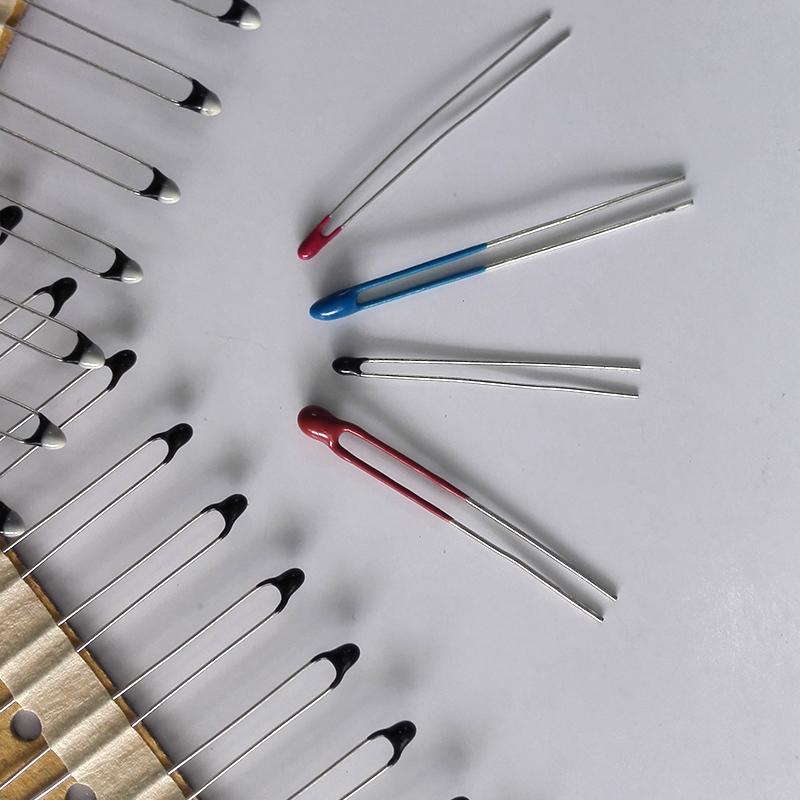
The ECT sensor has to sit in coolant, so it is threaded into a coolant passage, usually in or near the thermostat housing, in the cylinder head or in a coolant passage of the intake manifold. On the Toyota 1GR-FE it threads into the cylinder block and is tightened to 20 N·m (15 ft·lbf), per the specification cited above. Bosch's NTC M12 uses an M12×1.5 thread, a 19 mm wrench and 25 Nm. Many engines also carry a second sensor or a gauge sender close by, and the two are easy to confuse. The vehicle's service manual shows which one feeds the ECU.
Focusens makes NTC thermistor elements and probes for sensor manufacturers. We do not sell replacement ECT sensors for specific vehicles, so for a repair, buy the part listed for your vehicle. Our automotive thermistor range includes the MF5A-3 epoxy NTC element, whose product page lists a 2.795 kΩ, B 4100 version among those used in automotive HVAC and coolant systems. 2.795 kΩ is the value GM table A gives at 25 °C; the product page does not state the reference temperature or how the B value is defined, so ask for the full resistance table. Our MF57 disc series data sheet lists "Temperature sensing and measuring in automobile cooling system" first among its typical applications. Because the curve is what the ECU depends on, send the OEM resistance table, or a sample, with an OEM inquiry so the element can be matched at the temperatures that matter, including the cold end. Our automotive thermistor guide covers where NTC and PTC parts are used in vehicles.
For the general background on NTC curves and B values, see how to select an NTC thermistor by R25 and B value and the NTC thermistor guide to B value and resistance curves. HVAC sensors follow different 10 kΩ curves, which are tabulated in our 10k thermistor chart, and our NTC vs PTC vs RTD vs thermocouple comparison covers the other sensor types.
On GM table A and the Bosch curve, a coolant temperature sensor reads about 240 Ω at 90 °C (194 °F): 241 Ω for GM table A and 243 Ω for Bosch. Other sensors differ, so check the maker's table.
A coolant temperature sensor's signal falls from near 5 V when very cold to under 1 V when fully hot. Toyota sets a fault code above 4.91 V (open circuit) or below 0.14 V (short). The voltage at a given temperature depends on the resistor inside the ECU, so use the vehicle's service data.
An unplugged coolant temperature sensor looks like an open circuit. The signal goes to near 5 V, the ECU reads about −40 °C and sets P0118. Toyota and Mitsubishi then use a fixed 80 °C substitute value.
A 10 kΩ reading at room temperature is not normal for the GM, Bosch or Toyota sensors on this page: they read 2.3 to 3.5 kΩ at 20 °C (68 °F), and the two GM tables give 2,796 Ω and 1,941 to 2,173 Ω at 25 °C (77 °F). A few coolant sensors are rated 10 kΩ at 25 °C, such as Delphi's 15425529, so check the part's own table. On GM table A, 10 kΩ means about −1 °C (30 °F); on GM table B it means about −11 °C (12 °F).
The ECT sensor and the gauge sender are not always the same part. Some vehicles have a separate sender for the gauge; on many newer vehicles the ECU sends the ECT reading to the instrument cluster over the CAN bus.
Reviewed by the Focusens Engineering Team on October 1, 2026. Resistance values, voltage limits and code descriptions come from the OEM and sensor-maker documents linked beside each table; some are third-party copies of OEM manuals and are marked as such. The voltage table, the wrong-curve table and the 10 kΩ temperatures are our calculations from those published values, and the method is stated under each. The circuit diagram is an illustration and the engine-bay image is AI-generated. No reading on this page is a measurement taken on a Focusens part.
No.1 XiSan Road, Electromechanical Industry Park , High&New Tech.Zone. Hefei,Anhui,China
tel : +86-551-69109668
Whatsapp : +86-13339100504
e-posta : info@focusens.com
Skype : melodyliu520






 +86-551-69109668